
Treatment
Currently, there is no cure for cerebral palsy. Therefore any medical treatment given to individuals with cerebral palsy is there to help the individual reach their greatest potential physically, mentally and socially. These therapies specifically help sufferers develop specific skills and abilities. The medical treatments and therapies are managed through a multidisciplinary team that oversees every possible aspect of an individual with CP's problems.
Medical therapy:
This involves treatment for all medical problems that are link to CP. Due to the ranging medical problems of this disorder; many different medical specialists are involved in the treatment of these problems.
- Digestive problems: These are common in CP sufferers, who often have gastroesophageal reflux (GERD). This causes severe heart burn and regurgitation of acid from the stomach. Individuals with CP also have difficulty in swallowing and have problems feeding. These problems are usually treated by gastroenterologist, nutritionist and a feeding and swallowing therapist. This team usually assesses the nutritional status of individuals with CP. The swallowing therapy helps the individuals with CP eat and drink independently and helps them prevent aspiration. Individuals that have severe swallowing problems are usually fed through a tube.
- Seizures: These are usually controlled through prescribed medication by neurologists.
- Breathing problems: This is due to CP sufferers being unable to control muscle movements so therefore find it difficult to control lung expansion and contraction. This is usually treated by a pulmonologist (lung specialist), who try and manage the resulting lung disease and breathing difficulties.
- Spasticity: The stiffness in muscles of individuals with CP is usually treated through injections into the muscle or by medications. This is done to try and reduce spasticity in CP sufferers allowing for a greater range of motion and reduce deformity in the body.
Physical therapy:
This involves individuals with CP doing activities such as stretching and physical exercise to develop their muscle tone, strength, flexibility and control. This is done to ensure that muscle function is maximised and reduce pressure in any joints. Specific goal of this treatment is to develop skills such as holding head up, sitting unsupported and walking. This is implemented through braces, splints and casts.
Other equipment that may be used in aid of these goals includes walkers, positioning device and customized wheel chairs.
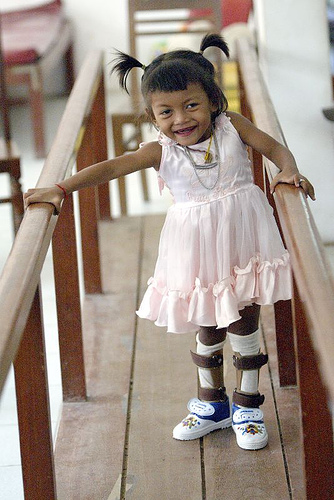
Image courtesy of flickr: https://www.flickr.com/photos/cambodiatrust/845631653/
under the common creative license law
Speech therapy:
This involves individuals with CP tackling their communication problems, due to poor muscle tone and coordination of the mouth and tongue. Speech therapy involves developing these muscles and improving speech quality. It also benefits individuals with hearing loss. Individuals who may not be able to speak also benefit with being provided with a computerized voice synthesizer.
Visual problems:
Many individuals with CP have strabismus and visual problems. These are usually treated by an ophthalmologist (eye specialist).
Educational therapy:
As CP affects individuals from early in their lives; many of these individuals are children. They are challenged in cognitive processes such as thinking, learning and memory as many CP sufferers have average or above average intelligence.